TL;DR: An obi wall hanging needs a wooden dowel, two brackets and nothing that touches the silk. Fold the obi so the visible panel is the height you want, rest the fold over the dowel, and let the surplus hang doubled behind. Never pin, nail, tape or glue vintage brocade, and never hang it in direct sun. The worked example below sizes the dowel and the panel for our champagne brocade obi, 31 by 440 cm, on a wall above a sideboard.
An obi wall hanging is the second thing a vintage obi does well, after the dining table, and in some rooms it is the better use. A formal obi is a long band of woven brocade with a pattern designed to be read vertically, from the knot at the back of a kimono downward. Hung on a wall it becomes a narrow panel with real relief, metallic thread that changes through the day, and a story in its motifs. The whole point of this guide is to get that panel up without harming a textile that has survived fifty or more years already.
Why does an obi wall hanging work better than a framed print?#
Three reasons, all physical. A woven obi has depth: brocade and embroidery sit above the ground cloth, and gold and silver threads catch light from the side, so the surface moves as you walk past. A print does not.
The proportions are unusual. A panel 31 cm wide and anything from 110 to 220 cm tall fills a slot of wall that framed art rarely fits: beside a doorway, between two windows, above a narrow console.
And it stays reversible. Hung from a dowel, the obi is exactly as it was found. Take it down and it is a table runner again for a dinner. Cut it to fit a frame and that option is gone for good, which is why we do not recommend framing a whole piece.
Which dowel and brackets do you need?#
A plain wooden dowel, round, 20 to 25 mm in diameter, is enough for any obi. Thicker looks heavy; thinner can bow under a long silk piece. Pale wood such as pine or oak disappears against a white wall; walnut reads as a deliberate frame.
Worked example with the champagne brocade obi, 31 cm wide:
- Add 8 to 10 cm to the obi width for the dowel length. 31 + 9 = 40 cm. A 45 cm dowel gives a slightly wider margin and is a common off-the-shelf size.
- Choose two open-top brackets, the kind sold for curtain rods or towel rails, spaced so the obi sits between them. For a 45 cm dowel, mount the brackets about 36 cm apart, centred, so the obi’s edges clear them by a couple of centimetres on each side.
- Sand the dowel ends and check the surface is smooth. A rough dowel snags silk.
- Fix the brackets into the wall with anchors suited to your wall. A folded fukuro obi weighs well under a kilogram, so this is not a load question; it is a levelling question. Use a spirit level.
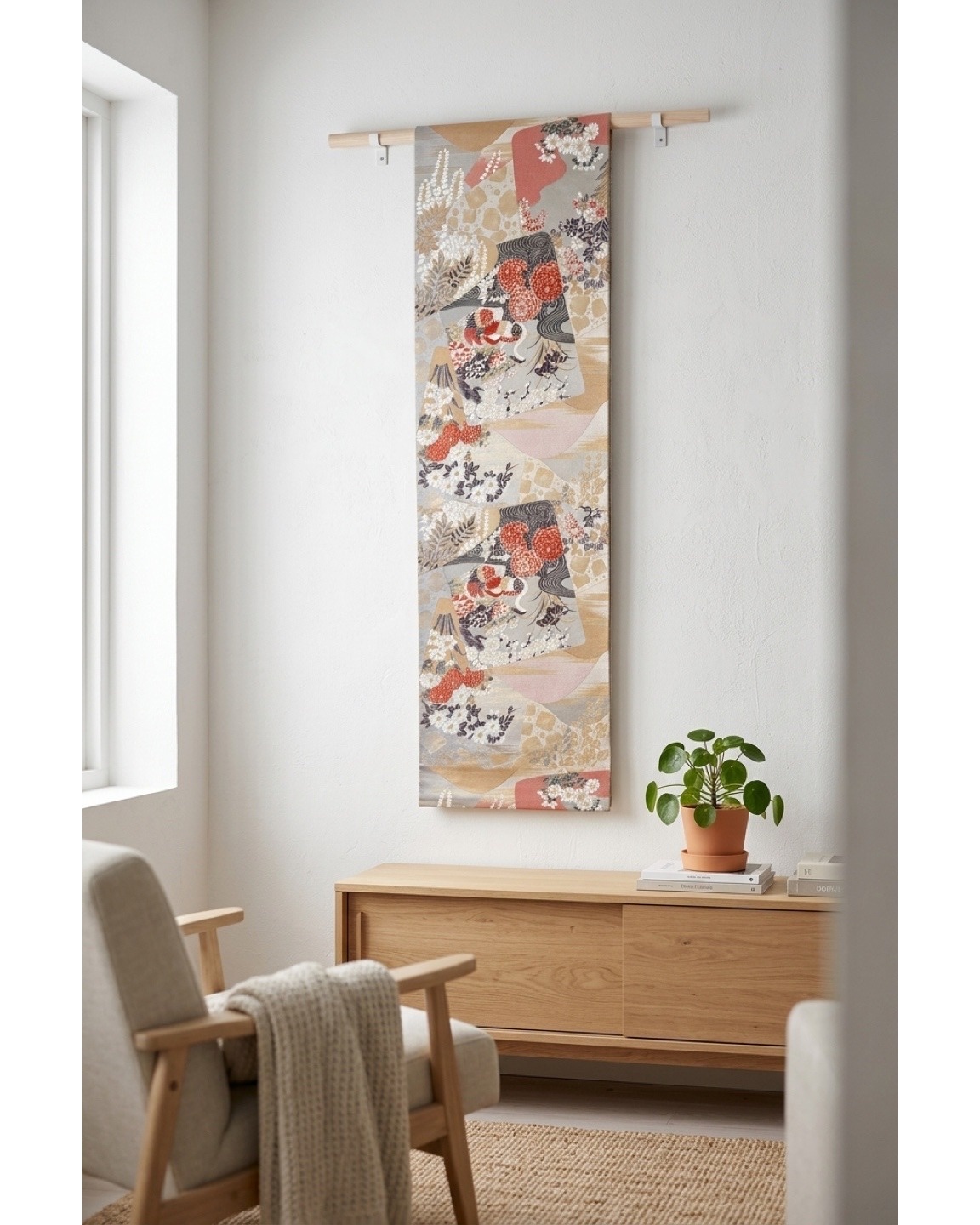
Styling visualization: an AI-generated room scene built from our own product photo of the champagne obi. Every generated image we publish is labelled as one.
How do you fold the obi to the height of your wall?#
An unfolded 440 cm obi is taller than any domestic wall, so you choose the visible height and fold the rest behind. The dowel sits inside the fold at the top, and the doubled fabric hangs behind the panel you see.
Continuing the worked example above a sideboard 80 cm high, on a wall with a 240 cm ceiling:
- Decide where the bottom edge should sit. About 15 cm above the sideboard looks right, so the bottom edge is at 95 cm from the floor.
- Decide where the top should sit. Leaving 30 cm of wall above the dowel keeps the panel from crowding the ceiling, so the dowel is at 210 cm.
- The visible panel is therefore 210 minus 95, which is 115 cm.
- Fold the obi so the front layer is 115 cm. With 440 cm of length, that leaves 325 cm behind. Fold that surplus back on itself in two or three even layers so it hangs flat, and let the doubled thickness give the panel a little body.
- Position the fold so the motif you want at eye level sits around 150 to 160 cm from the floor. On the champagne obi that is the central shikishi panel with the red chrysanthemums and the wave passage.
Because a fukuro obi has its pattern along the full length, you can shift the fold to bring a different section to the front whenever you want a change. That is a feature no frame gives you.
What should you never do to a vintage silk obi on a wall?#
Never pierce it. No nails, pins, tacks or staples through the brocade, ever. A hole in silk does not close, and a pin through metallic thread breaks it. The dowel exists so that nothing needs to pierce the fabric.
Never stick it. Double-sided tape, adhesive strips and hook-and-loop backing all leave residue on silk and pull threads when removed. The obi should rest on the dowel by its own weight.
Never hang it in direct sunlight. This is the same care rule printed on every listing. Sun fades silk dye and dulls gold and silver thread, and on a wall the exposure is all day, every day. Choose a wall that light crosses rather than one it hits.
Never hang it over a radiator or heater. Dry heat makes silk brittle over time and sets any existing fold line permanently.
Never try to press out fold lines with an iron on the front. Light fold lines from storage are normal on every vintage obi and will relax once the piece hangs under its own weight for a few weeks. If you want to hurry that, hold a hand steamer at a distance from the back. A hot iron on brocade flattens the relief that makes the piece worth hanging.
Which obi hangs best?#
Pieces with a strong single motif read best from across a room. The gold-and-charcoal crane obi from our first listing, with its cranes and peonies over a flowing stream, is a wall piece before it is anything else. A quiet silver-on-ivory design such as our silver brocade obi works on a wall in a smaller room where you see it up close, and it looks like calm linen from a distance.
One thing we want to be plain about: the room scene above is a styling visualization, generated from our own product photograph so you can see the obi at scale on a wall, and we say so under every one. The flat product photo of the same piece is on the listing next to it, alongside the condition notes. We photograph and disclose every defect we find, because in a category that sells on trust the disclosure is the product as much as the silk is. A buyer who has read the real condition of a piece and seen a labelled visualization of it on a wall knows exactly what will arrive.
See the current pieces in the KINU Tokyo shop, and measure the wall before you choose.