TL;DR: A Japanese obi table runner needs no cutting, because a formal obi is already 30 to 40 cm wide and 3.5 to 4.5 m long. Fold it in half for a full-length runner, in thirds for a centre panel, or in quarters to lay across the table, and use the arithmetic below to match your table exactly. Keep plates and heat on the wood beside it, spot clean only, and store it rolled. The five styles below use our two current pieces, the champagne brocade and the silver brocade, as worked examples.
Search for a Japanese obi table runner and you will see the same photograph over and over: a long band of brocade down a dark wooden table. It is the obvious use and it is a good one, but a 440 cm length of silk gives you far more options than that. Here are five, with the folds worked out for real table sizes, plus the rules that keep a vintage piece safe through an actual dinner.
Why does a Japanese obi table runner fit without cutting?#
An obi was woven to wrap a kimono twice and then form a large decorative knot at the back, which is why the formal fukuro type is so long. The two fukuro obi in our shop measure 31 by 440 cm and 30.5 by 440 cm. Both are late Showa, both silk brocade, both one of one.
Fold either in half and you have a 220 cm runner, 31 cm wide, with the pattern on the outside of both layers because a fukuro obi is patterned along its full visible length. Fold it in thirds and you have roughly 147 cm. Fold it in quarters and you have 110 cm. Every one of those is a useful table dimension, and none of them involves scissors, which matters because the moment an obi is cut it stops being an obi.
How do you fold it to the right length?#
Start with two numbers: your table length and the drop you want at each end. Then pick the fold that gets closest.
Worked example with the champagne brocade obi, 31 by 440 cm:
- Measure the table. Say it is 180 cm long.
- Decide the drop. A 15 to 25 cm overhang at each end looks intentional; anything longer starts to sweep chairs.
- Add them: 180 + 20 + 20 = 220 cm.
- Fold the obi in half. 440 divided by 2 is 220 cm. That is an exact match, so lay it down with the fold at one end and the two raw ends together at the other.
Same obi on a 240 cm table? Folded in half it is 20 cm short, so run it unfolded but doubled back on itself at one end, or accept the panel look and let it stop 10 cm short at each end. On a 140 cm table, fold it in thirds for 147 cm and let it sit almost flush. Fifteen minutes with a tape measure saves guessing at the shop.
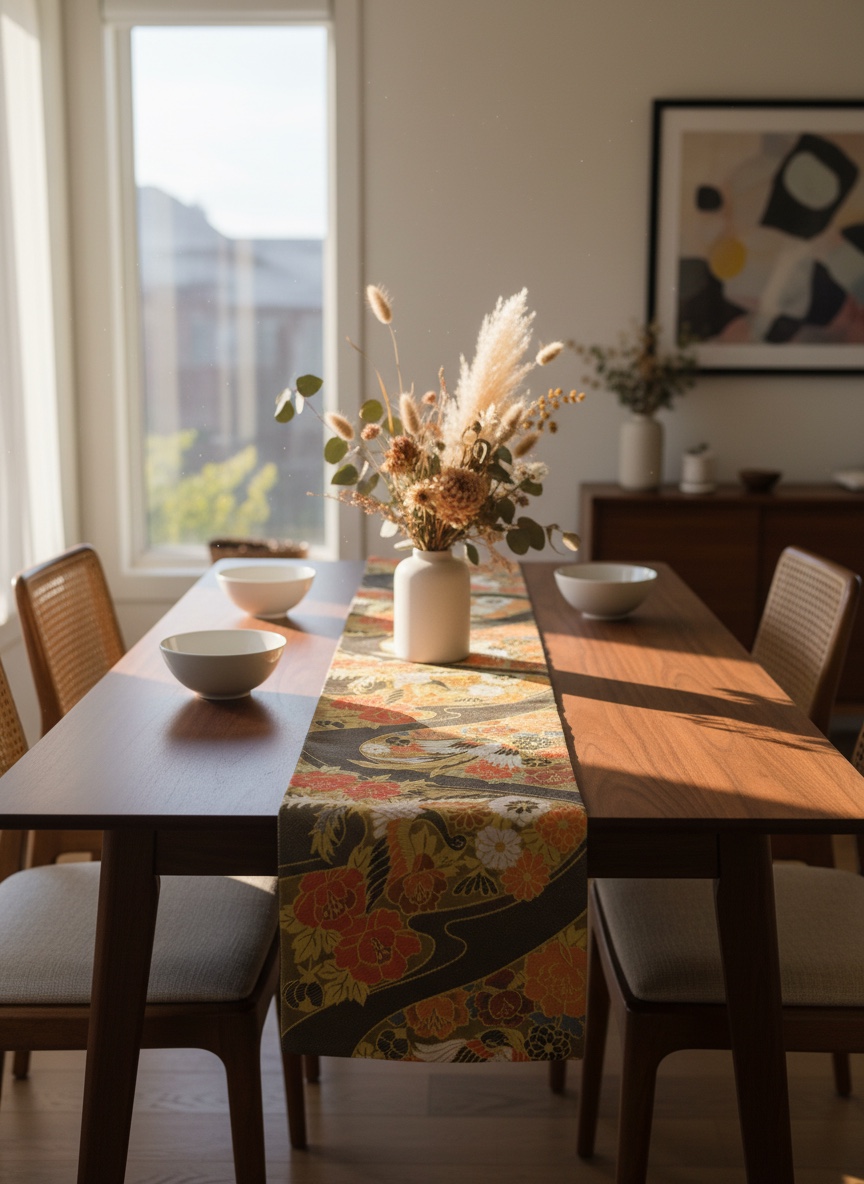
Styling visualization: an AI-generated room scene built from the product photo of our first listing, a crane and peony fukuro obi. We label every generated image.
What are the five ways to style it?#
1. The full-length centre runner#
Fold in half, lay down the centre line of the table, and place a low vase or a bowl of fruit in the middle. Set the plates on the wood on either side. This is the style in the picture above and the one that shows the whole pattern at once. It suits a bold piece like the crane obi, where the motif repeats along the length and you want to read the whole story.
2. The short centre panel#
Fold in thirds so the obi sits inside the table edges with no drop. This looks more like a placed object than a runner and works well on a round or square table, or on a long table where you only want the centre third dressed. The silver obi is the better piece here: it reads as calm ivory linen from across the room and reveals its multicolour blossom clusters only when someone sits down.
3. Across the table, for two#
Fold in quarters to about 110 cm and lay the obi across the width of the table rather than along it. On a 90 to 100 cm wide table that gives a small drop on each side and frames two place settings facing each other. Good for a kitchen table, a breakfast for two, or the head of a long table on a night when only two people are eating.
4. The wedding or anniversary table#
The silver obi was listed with a wedding tablescape in mind, and the reason is practical. A pale silver brocade sits under white flowers and glassware without fighting them, while the diagonal panels of tiny blossoms in yellow, blue, red, green and mauve give the table colour that a plain linen cannot. Fold in half, run it the length of the top table, and keep the florals low so the pattern stays visible. Because each obi is one of one, a long run of matched tables is not something we can supply, so this style is for the one table that matters.
5. The console, sideboard or bench#
Fold in thirds and lay the obi along a console or sideboard, or across the foot of a bed or a hallway bench. This is the quietest use and the one that works in rooms with no dining table at all. On a console, let it hang 10 to 15 cm over each end. On a bench, centre it and let both ends fall.
How do you protect the silk during dinner?#
The care line on every listing is short: spot clean only, keep out of direct sunlight, store rolled, not creased. On a table that translates into three habits.
Keep food and drink off the runner. Plates, glasses and serving dishes go on the wood or on placemats beside it, and hot dishes go on trivets. The runner is the centrepiece strip, not the placemat, and once you set the table that way it stops feeling like a restriction.
Keep it out of the sun. A table under a south-facing window will fade silk dye over years and dull gold and silver thread. If the table gets direct light, roll the runner away in the afternoon or use it for evenings.
Roll it between uses. Fold lines from decades of storage are normal on every vintage obi. They relax when the piece lies flat on a table for a few days or with a gentle steam held at a distance. What sets a crease permanently is folding it the same way every time and stacking weight on it, so store the obi rolled around a cardboard tube.
Which obi should you choose for a table?#
Two questions settle it. First, does the room want a statement or a texture? A gold-and-charcoal piece with cranes and flowing water is a statement, and it wants a plain table and plain plates. A silver-on-ivory piece is a texture, and it can carry patterned ceramics and coloured glass. Second, will you read the motifs? Cranes, pine, plum and chrysanthemum all mean something, and a runner covered in wedding symbols is a different object once you know it. Our motif guide walks through them.
Whichever you choose, you are buying a reconstructed story rather than a length of fabric. A mass-market runner is a product with a restock date. An obi was woven for one family’s celebrations, worn a handful of times, kept for decades, and then found by Amal in a Tokyo market and checked by hand before it was listed. That is why it costs what it costs, and why the piece you choose will not be there next month.
See what is currently available in the KINU Tokyo shop, and measure your table before you look.