TL;DR: The Japanese crane motif meaning is long life and a faithful marriage, which is why cranes cover formal obi woven for weddings. Around them you will find pine, bamboo and plum (the three friends of winter), chrysanthemum, peony, cherry blossom, folding fans, shikishi poem cards, and geometric grounds such as asanoha hemp leaf and ishidatami stone pavement. Each carries a wish. Read them together and a vintage obi stops being a strip of fabric and becomes a story you can tell at your own table.
Ask what the Japanese crane motif meaning is and you get the short answer, longevity, but a formal obi never carries the crane alone. It sits among a dozen other symbols, each chosen because of what it wishes on the wearer, and the way they combine is the point. Every motif below appears on the three obi we have listed so far, so you can check each one against a real piece rather than a diagram.
What is the Japanese crane motif meaning on an obi?#
The crane, tsuru in Japanese, is the most auspicious bird in the Japanese textile vocabulary. Folk tradition holds that it lives a thousand years and takes a single mate for life, and the red-crowned crane, the species behind the motif, does in fact pair for years. On a formal obi the crane therefore carries two wishes at once: a long life and a lasting marriage.
That is why cranes appear so often on fukuro obi, the formal type worn to weddings and ceremonies. Our first listing was a gold-and-charcoal fukuro obi with cranes in flight over a flowing stream, surrounded by peonies and chrysanthemums. A piece like that was woven for a celebration. Whose celebration, we do not know, and we will not invent it. What we can say is what the weaver intended the piece to wish, and that is enough to change how it sits on a dining table.
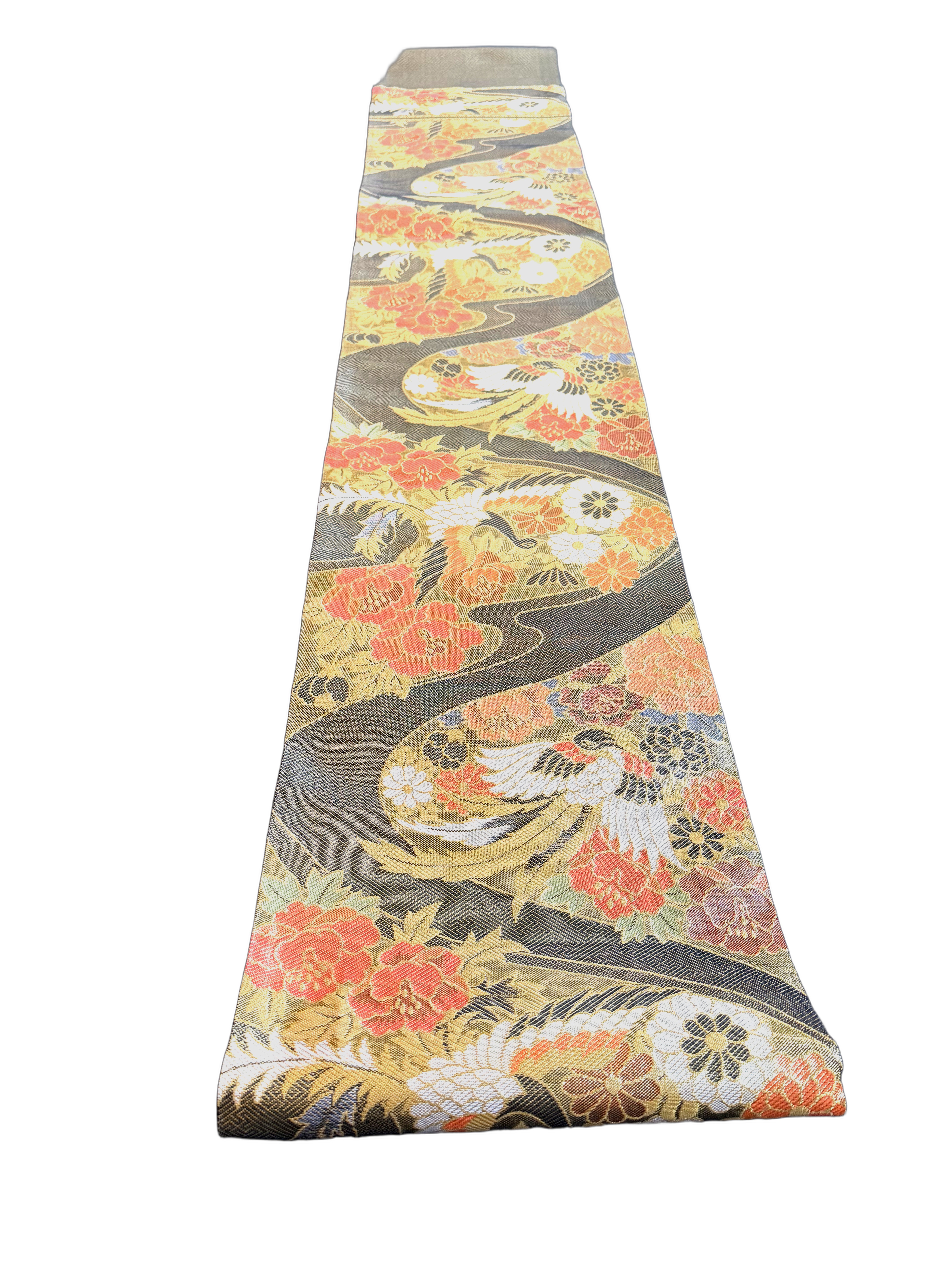
Product photo of our first listed obi: cranes in flight over a winding stream, with peonies and chrysanthemums. No generated elements.
Which plants carry the luckiest meanings?#
Pine, bamboo and plum. Together they are shochikubai, known in Chinese and Japanese art as the three friends of winter. Pine stays green through the cold, bamboo bends without breaking, and plum blossoms while snow is still on the ground. As a trio they wish endurance, resilience and good fortune, and their presence on an obi usually marks it as a piece for the most formal occasions.
Plum blossom on its own. Plum is the first tree to flower each year, so a branch of plum stands for perseverance and the promise of spring. On our champagne brocade obi, trailing branches of plum are worked in fine silver embroidery across the panels.
Cherry blossom. Sakura is the opposite wish from pine: beauty that lasts a few days. It stands for the passing season and for appreciating the moment. It shares the silver embroidery with the plum on the champagne obi.
Chrysanthemum. Kiku is the flower of autumn, of long life, and of the imperial household, whose crest is a sixteen-petalled chrysanthemum. Clustered chrysanthemums in deep red and white sit inside the shikishi panels of the champagne obi, and chrysanthemum-like blossoms run through the silver-on-silver ground of the silver obi.
Peony. Botan is the king of flowers in the Chinese tradition that Japanese weavers inherited, and it stands for wealth, honour and good fortune. Peonies in orange and red fill the ground around the cranes on our first obi and share the panels with the chrysanthemums on the champagne piece.
What do the geometric grounds mean?#
Behind the flowers and birds, a formal obi almost always has a repeating geometric ground, and those patterns carry meaning too.
Asanoha, the hemp leaf. A six-pointed star lattice built from hemp leaves. Hemp grows fast and straight, so asanoha was traditionally used on children’s clothing as a wish for healthy growth. On the silver obi in our shop, subtle asanoha geometry runs underneath the whole composition and gives it what our listing calls a courtly, almost architectural rhythm.
Ishidatami, the stone pavement. A checkerboard of squares named after paving stones. It stands for continuity and for a path that goes on, and it is one of the oldest ground patterns in Japanese weaving. On the champagne obi a gold-mosaic ishidatami ground catches the light at every angle.
Water and waves. Flowing water stands for purity and the passage of time, and stylised wave passages give a composition movement. The winding stream on our crane obi does exactly that: it carries the cranes across the length of the piece.
What are shikishi and folding fans doing on a sash?#
Two motifs on our current pieces come from paper rather than nature.
Shikishi. These are the square or rectangular cards on which poems and paintings were written and given as gifts. A shikishi panel on an obi is a frame within the frame: the weaver places a small scene, often flowers, inside a card shape, and scatters the cards across the ground. The champagne obi holds its chrysanthemums and peonies inside shikishi-style panels; the silver obi is built around a diagonal patchwork of them, each filled with clusters of tiny multicoloured blossoms.
Sensu, the folding fan. A fan opens from a single point into a wide arc, so it stands for expanding fortune and a future that widens. Folding fans in champagne gold and dusty rose are the first motif you notice on the champagne obi, which is why its listing leads with them.
How do you read a whole obi at once?#
Here is the method we use, applied to the champagne brocade obi so you can repeat it on the listing photographs.
- Find the ground. Ishidatami stone pavement in brushed gold, with stylised waves passing through it. Continuity and movement.
- Find the frames. Shikishi panels scattered across the ground, tilted like dropped cards.
- Read inside the frames. Clustered chrysanthemums (autumn, long life) and peonies (wealth and honour) in deep red and white.
- Read the branches. Plum (perseverance) and cherry (the passing season) in silver embroidery, trailing across the panels.
- Find the fans. Sensu in gold and dusty rose: expanding fortune.
- Put it together. A wish for a long, honourable life, with fortune that keeps widening and the patience to wait out winter, offered on a garment worn at celebrations.
Do the same on the silver obi and the reading is quieter: asanoha for growth, shikishi cards for gifts, and blossom clusters in soft yellow, blue, red, green, mauve and ivory for abundance. On the crane obi it is the most direct of the three: cranes for a long marriage, peonies for honour, water for time passing.
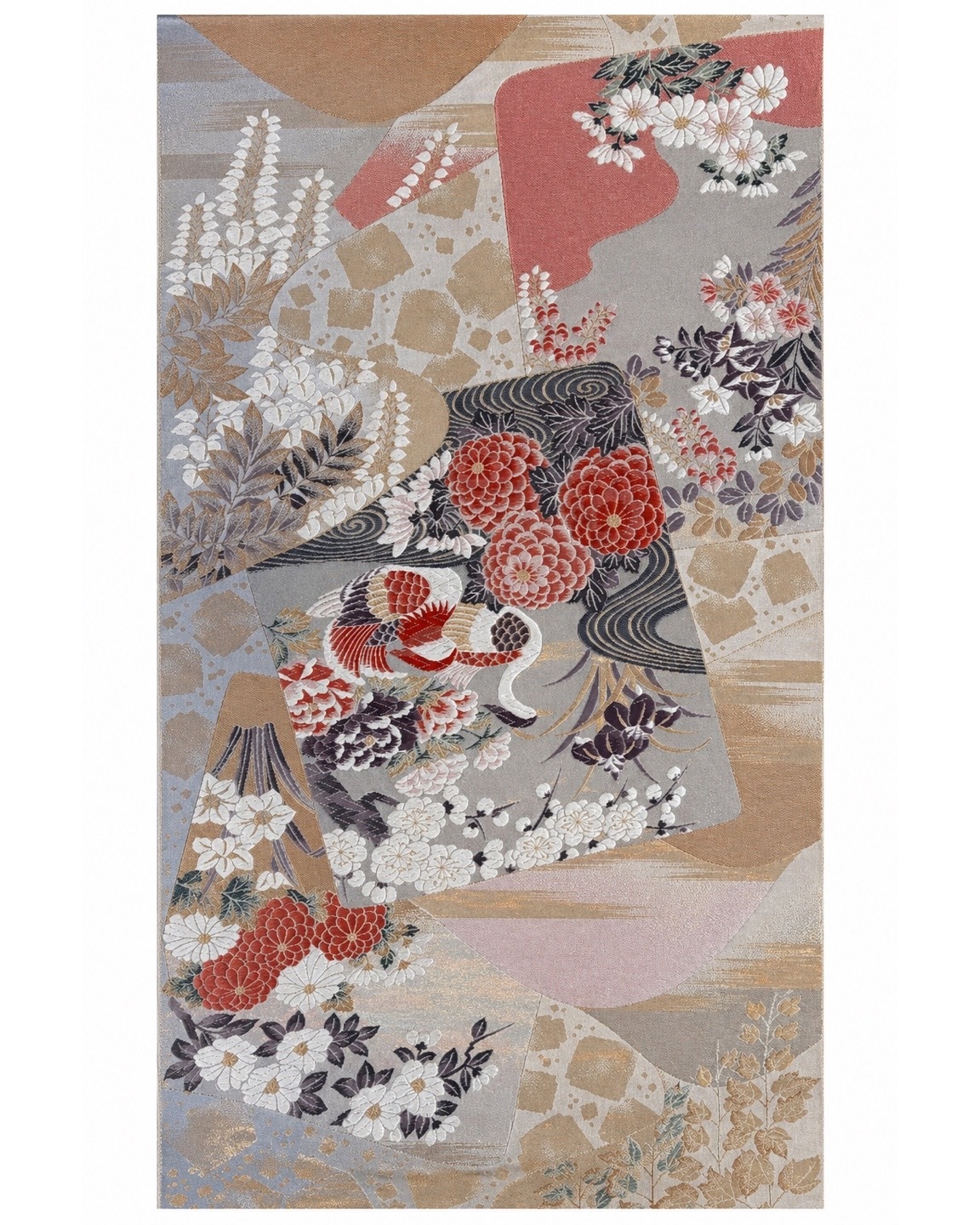
Product photo of the champagne brocade obi described in the worked example above.
Does the meaning change what you should buy?#
It changes what you are buying. A mass-market runner is a pattern. A vintage obi is a set of wishes chosen by a weaver and a family for a particular occasion, carried through decades of storage, and now on your table. When a guest asks about the birds, you can tell them. That story is a large part of what the price pays for, and it is why a piece with a story is one people keep rather than return.
Two practical notes follow from it. Abstract and geometric grounds, such as asanoha and ishidatami, cross cultures most easily and suit a room where the obi should read as texture. Figurative motifs, cranes above all, are statements, and they suit a plain table or a wall where they can be read at eye level. Our obi wall hanging guide explains how to position the motif you want at that height.
Every piece in the KINU Tokyo shop is listed with its motifs named, alongside its fabric, era, dimensions and condition, and each one is one of one. If you want to know what a particular pattern means before you choose, ask, and we will read it for you.