TL;DR: If you want to know how to tell silk from polyester obi, four tests cover it: silk feels warm in the hand and polyester cool; silk has a soft, shifting sheen while polyester shines evenly; a single loose lining thread of silk burns to crushable ash while polyester melts into a bead; and the reverse side of a silk obi shows fine, fraying filaments rather than uniform springy ones. The difference is the largest single factor in what an obi is worth, so learn the tests and you will understand every price you see, including ours.
Most listings for vintage obi say “silk” in the title and nothing further. Some of them are right. Knowing how to tell silk from polyester obi yourself is the difference between paying a silk price for a polyester sash and knowing exactly what you are holding. We would rather you could grade a piece the way we do, because the buyer who can tell the difference is the buyer who understands why one obi is $45 and another is $280.
Why does silk versus polyester change the price so much?#
Fabric is the first thing we record on every piece, before weave, era or motif, and it is the first split in the price. Pure silk sits at the top, silk blend below it, polyester at the bottom. Our pricing bands follow that order: an entry piece in polyester, good condition, from the 1970s or later, lists at $45 to $65; a mid piece in silk blend from the Showa era at $85 to $130; a premium piece in pure silk from Meiji or Taisho at $160 to $280. The two fukuro obi currently in the shop are silk brocade with metallic thread, late Showa, at $130 and $145.
The reason is not snobbery. Silk is a protein filament spun by a silkworm; polyester is an extruded plastic. Silk takes dye deeply, holds a relief weave, ages into a softer hand, and was the only fibre used for formal obi until synthetics arrived in the second half of the twentieth century. Polyester obi exist because they were cheaper to make and easier to care for, and a vintage polyester piece is an honest garment. It should simply cost less.
Test 1: How does it feel in your hand?#
Hold the obi with your palm flat on the plain part of the surface for ten seconds. Silk feels warm almost at once, because it conducts heat away from your skin slowly. Polyester stays cool and slightly slick, and the coolness does not fade.
Then let the fabric fall. Silk drapes with weight and settles; polyester springs slightly and holds air. On a fukuro obi the face is stiff with brocade, so do this test on the lining side or the plain end section, where there is less pattern and more ground cloth to feel.
This test alone is right most of the time, and it is the one you can do at a market stall with the seller watching.
Test 2: What does the light do on the surface?#
Take the obi to a window or hold it under a single lamp and tilt it. Silk has a lustre that shifts as the angle changes, brighter along one axis, softer along another, because the filaments are triangular in cross-section and bend light. The effect is a glow rather than a shine. Polyester reflects evenly from every angle, with a flat brightness that reads as plastic once you have seen the two side by side.
Metallic threads complicate this on a brocade, so judge the ground cloth between the motifs rather than the gold or silver passages. On the silver obi in our shop, the ivory and pale grey ground between the diagonal panels is the place to look.
Test 3: What happens to a loose thread near a flame?#
This is the decisive test and the one that needs care. Never hold a flame near the obi itself. Find a single loose thread at a raw end or on the inside of the lining, pull it free, and hold it in tweezers over a sink.
Touch a lighter flame to the thread. Silk burns slowly, curls away from the flame, smells like burnt hair, and leaves a soft black ash you can crush to powder between your fingers. Polyester melts before it burns, shrinks from the flame into a hard round bead, and smells sharp and chemical. A silk blend does both: the thread chars but a small bead forms at the tip.
One thread is enough, and it should come from the lining, never from the patterned face. On a piece with gold or silver thread, avoid the metallic passages entirely, because a metallic thread is usually a paper or film core wrapped in silk or synthetic and will not give a clean result.
Test 4: What does the reverse side tell you?#
Turn the obi over, or open the end of a fukuro obi where the two layers meet, and look at the thread ends and floats on the back. Silk filaments are fine and irregular; where they are cut they fray into a soft fuzz and the loose ends do not spring back into shape. Polyester filaments are uniform in thickness, shiny along their whole length, and a cut end stays crisp and springs back when you press it.
The reverse is also where era and provenance clues live: the weave floats, the way the lining is joined, and occasionally a woven maker’s mark near one end. Nishijin-ori pieces from the Kyoto weave houses are the gold standard for provenance, and when we can attribute a piece to a weave house we say so in the listing. When we cannot, we say that too.
Worked example: how to tell silk from polyester obi on our champagne piece#
Here is how the four tests run on the champagne brocade fukuro obi currently listed, 31 by 440 cm, described as silk brocade with gold and silver metallic threadwork, late Showa.
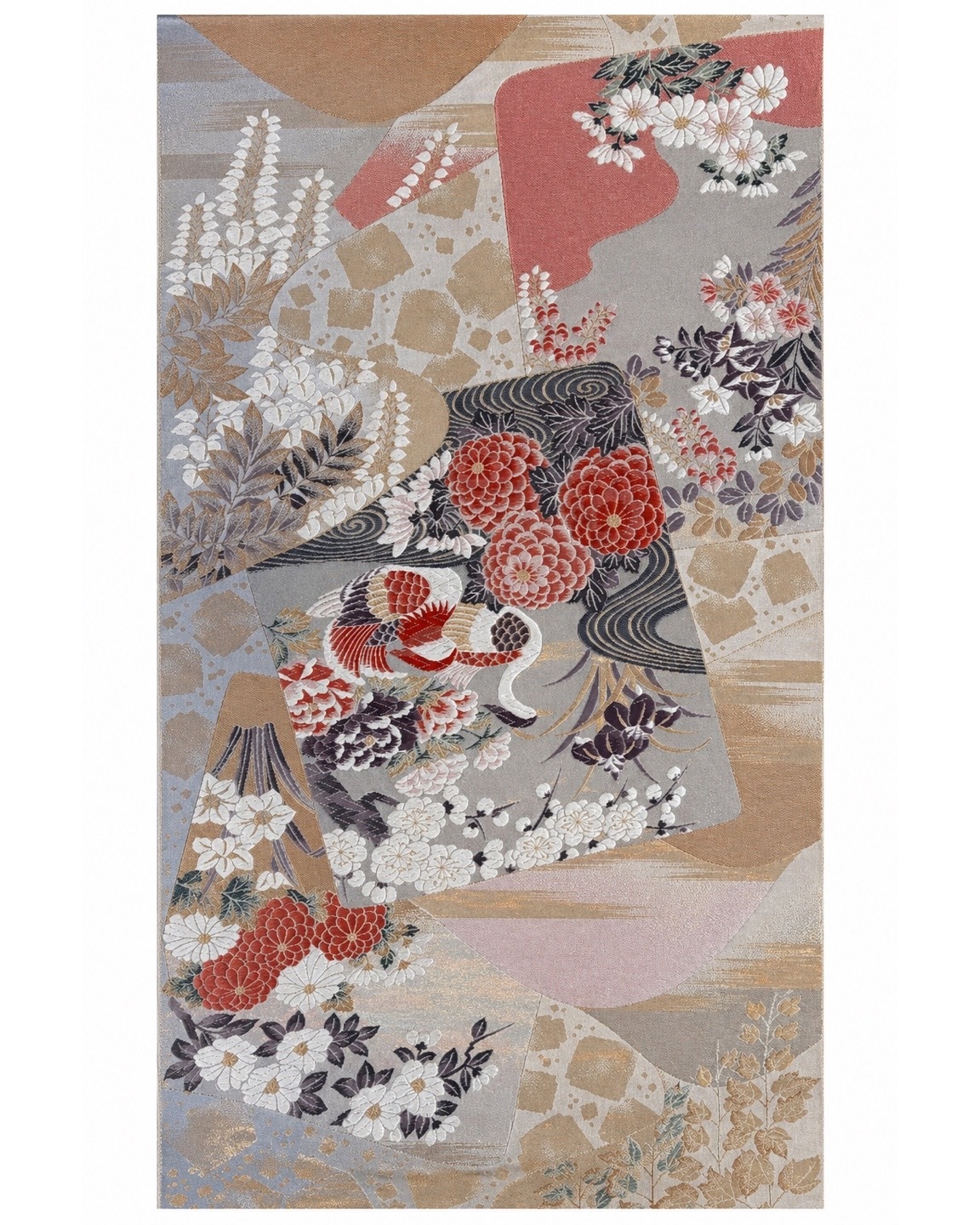
Product photo, background removed, no generated elements.
- Hand. Palm on the plain taupe end section: warm within seconds, and the fabric settles when released.
- Light. Tilted under a window, the champagne ground glows and darkens along one axis; the brushed gold passages shine on their own and are ignored for the test.
- Thread. One loose thread from the inside of the lining, held in tweezers over the sink: it chars, smells of burnt hair, and crushes to powder. No bead.
- Reverse. The thread ends inside the end seam fray into soft fuzz and stay put.
All four agree with the listing. We then grade condition on the same pass: this piece is excellent, with light fold lines from storage that relax with use or a gentle steam, and no stains, moth holes or fraying. That grade, the dimensions and the defects are written into the listing exactly as found. We photograph and disclose everything, because one undisclosed flaw costs more in trust than any sale earns.
What should you do with the result?#
If a piece passes all four tests as silk, its price should reflect it, and you can go on to the harder questions: which weave, which era, which motifs. Our guide to vintage Japanese textile decor covers the era ladder and the four obi types.
If it fails and turns out to be polyester, nothing is wrong with the piece. It will still fold into a runner or hang from a dowel, and it will cope with a sunny wall better than silk would. It should be priced as polyester, and a seller who called it silk owes you an explanation.
We publish this method rather than keeping it to ourselves because the knowledge is the point. A buyer who can tell silk from polyester can read our listings, check them against the piece that arrives, and see that the price was earned. That is the only kind of trust worth having in a category built on vintage. Every piece in the KINU Tokyo shop is listed with its fabric, era, dimensions, grade and defects, and you are welcome to check them.