TL;DR: An obi is the wide sash worn over a kimono, and it is the rare piece of vintage Japanese textile decor that works at home with no alteration at all. Most are 30 to 40 cm wide and 3.5 to 4.5 m long, so one folds into a table runner or hangs from a dowel as a wall panel. This guide explains the four obi types you will meet, how to read fabric, era, condition and motif before you buy, where KINU Tokyo’s pieces come from, and how to keep silk looking right for decades. Every obi we sell is one of one, found by hand in Japan by someone who lives there.
Search for vintage Japanese textile decor and most of what comes back is new fabric printed to look old, cut into cushion covers by a factory that has never seen a kimono. A vintage obi is a different kind of object. It was woven as a single formal garment, worn at a small number of ceremonies, folded away for decades, and it arrives at your door as the same uncut length of silk it always was. That is why it looks right on a dining table or a wall in a way that a reproduction never quite does.
What is an obi, and why does it make such good decor?#
An obi is the sash that closes and decorates a kimono. Formal women’s obi are long, stiff, densely patterned bands, because the whole garment was designed to be seen from behind when tied into a knot at the back.
Those proportions are the reason obi make such natural home pieces. A band 30 to 40 cm wide and 3.5 to 4.5 m long is already the shape of a table runner. Folded once it becomes a narrow vertical panel the height of a wall. Nothing needs to be cut, hemmed or backed. The two pieces currently in our shop measure 31 by 440 cm and 30.5 by 440 cm, which is typical.
The other reason is density. A formal obi carries its pattern in woven brocade and embroidery rather than print, so the surface has relief and the metallic threads catch light differently through the day. On a table it reads as a piece of art rather than a piece of cloth.
Which obi types will you actually see for sale?#
Four types cover almost everything on the market, and they sit in a rough order of formality and value.
Fukuro obi. The formal full-length type, and what both of our current listings are. Fukuro means pouch, because the patterned face and a plainer lining are woven or sewn as two layers. These are worn for weddings and ceremonies, so they carry the richest brocade and the most auspicious motifs.
Maru obi. An older, fully patterned formal type where the design runs across the whole width on both sides. Heavier and rarer than fukuro.
Nagoya obi. A lighter everyday type, partly pre-folded to make tying easier. Shorter and simpler, often with a single motif placed where the knot would sit.
Hanhaba obi. Half-width, casual, worn with summer cotton kimono. Narrow enough that as decor it works as a shelf runner or a bookcase accent rather than a table piece.
For decor, fukuro and maru obi are the pieces worth paying for, because they were made to be looked at.
How do you read fabric, era and condition before you buy?#
This is the part most listings skip, and it is where the price is decided.
Fabric. Pure silk sits above silk blend, which sits above polyester. Silk feels warm in the hand and polyester feels cool. A loose thread from the lining of a silk obi burns cleanly to soft ash, while polyester melts into a hard bead. Our companion post on silk versus polyester walks through four tests you can run at home.
Weave. Nishiki brocade, tsuzure hand-woven pictorial weave, and ro gauze all command a premium over plain weaves. Nishijin-ori, the Kyoto weave-house tradition, is the gold standard for provenance.
Era. Older is generally more valuable, in this order: Meiji (before 1912), Taisho (1912 to 1926), early Showa (1926 to 1960), late Showa (1960 to 1989). Both of our current pieces are late Showa, and we say so in the listing rather than rounding up.
Condition. Look for hidden stains under folds, moth holes, edge fraying and colour fade. Light fold lines from storage are expected on any vintage obi and are not damage. We grade every piece A through D, and a piece with a disclosed small stain is priced lower than a mint one. Whatever we find, we photograph and write down.
What do the motifs mean, and does it matter?#
Formal obi are covered in symbols chosen for the occasion. Cranes stand for long life and a lasting marriage. Pine, bamboo and plum together are the three friends of winter, a wish for endurance. Chrysanthemums, peonies and folding fans each carry their own meaning, and geometric grounds such as asanoha hemp leaf and ishidatami stone pavement carry theirs. Our post on Japanese textile motifs and their meanings reads each one in detail.
Does it matter for a dining table? It matters more than you might expect. A runner covered in cranes was woven for a celebration, and once you know that, the object on your table has a story to tell your guests. Abstract and geometric designs cross cultures most easily, while figurative pieces reward the buyer who wants to know what they are looking at.
Where do KINU Tokyo’s obi come from?#
Most “Japanese vintage” sold online is bought wholesale by resellers in the United States or Europe who never see the market where it was found. Our pieces are chosen by Amal, who lives in Tokyo and handles every one herself. The sourcing calendar is not a secret: the Oedo Antique Market at Tokyo Big Sight on the first and third Sunday of the month, the recycle shops of Nishi-Ogikubo, daily browsing of Yahoo Auctions Japan, and a house in Tomi, in the Nagano countryside, where estate clear-outs and rural recycle shops turn up early Showa pieces that never reach Tokyo dealers.
Proximity is the product. The person who chose your obi was standing in the stall, checking the reverse, running a hand over the silk and deciding it was good enough to carry home. That cannot be dropshipped, and it is the reason we can describe each piece the way we do.
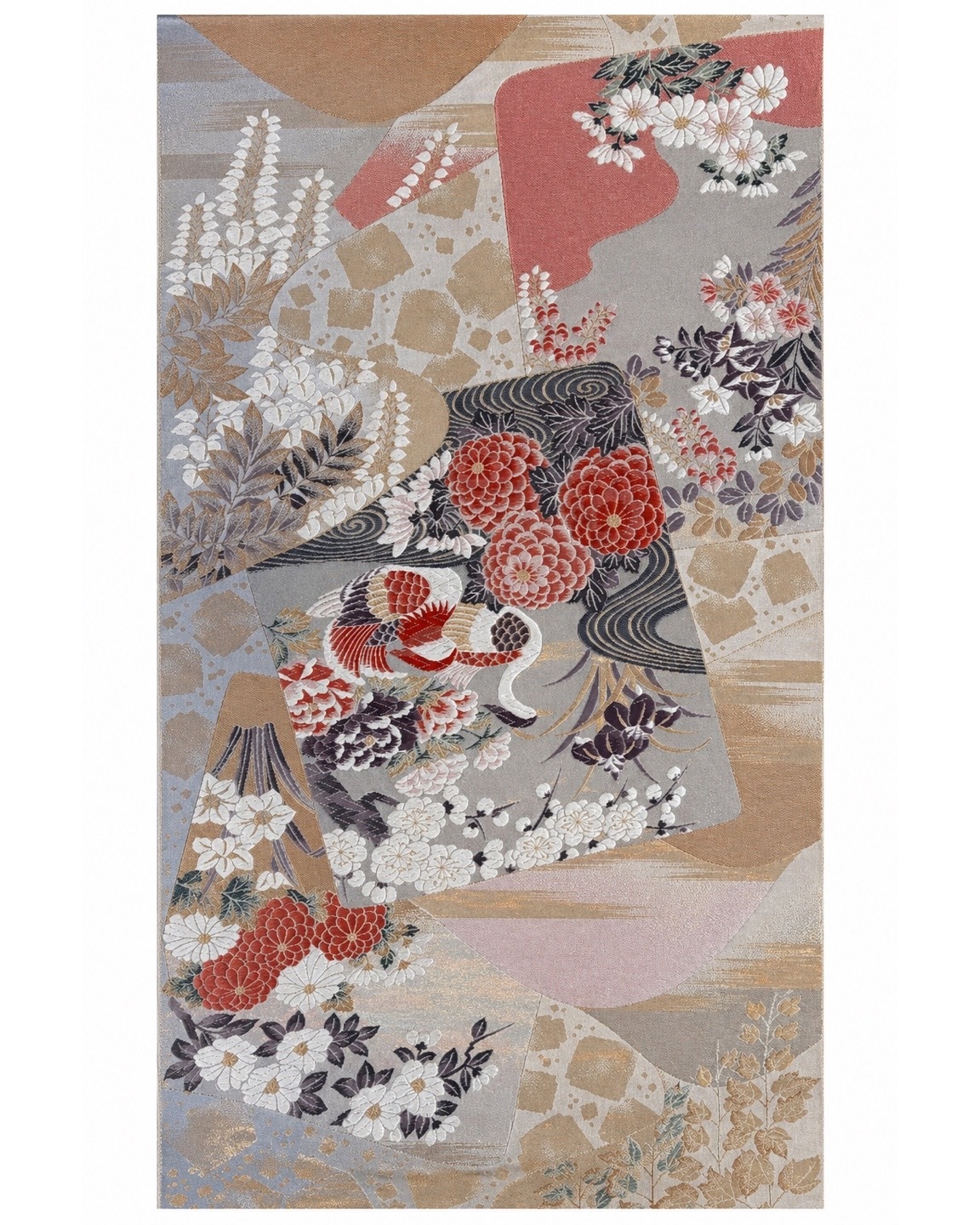
Product photo of a late Showa fukuro obi, 31 by 440 cm, currently listed at $130.
How do you style vintage Japanese textile decor at home?#
Three uses cover most homes, and all three come straight from how the pieces are built.
Table runner. Fold the obi in half down the length and lay it along the table centre. For a worked example, take the 440 cm champagne obi above and a 180 cm dining table. Folded in half the obi is 220 cm long, so you get a 20 cm drop at each end and the full 31 cm width down the middle. Set bowls and plates on the wood on either side, keep hot dishes on trivets, and the runner stays untouched through dinner. Our post on styling an obi table runner has five variations.
Wall hanging. Rest the fold over a wooden dowel on two wall brackets and let the panel hang doubled. The dowel takes the weight, so no pin or nail ever touches the silk. The full method, including dowel length and what to avoid, is in the obi wall hanging guide.
Console, sideboard or bench. Lay the obi folded in thirds along a console or across the foot of a bed. This is the quietest use and suits the more restrained pieces, such as the silver obi that reads as ivory linen from across a room.
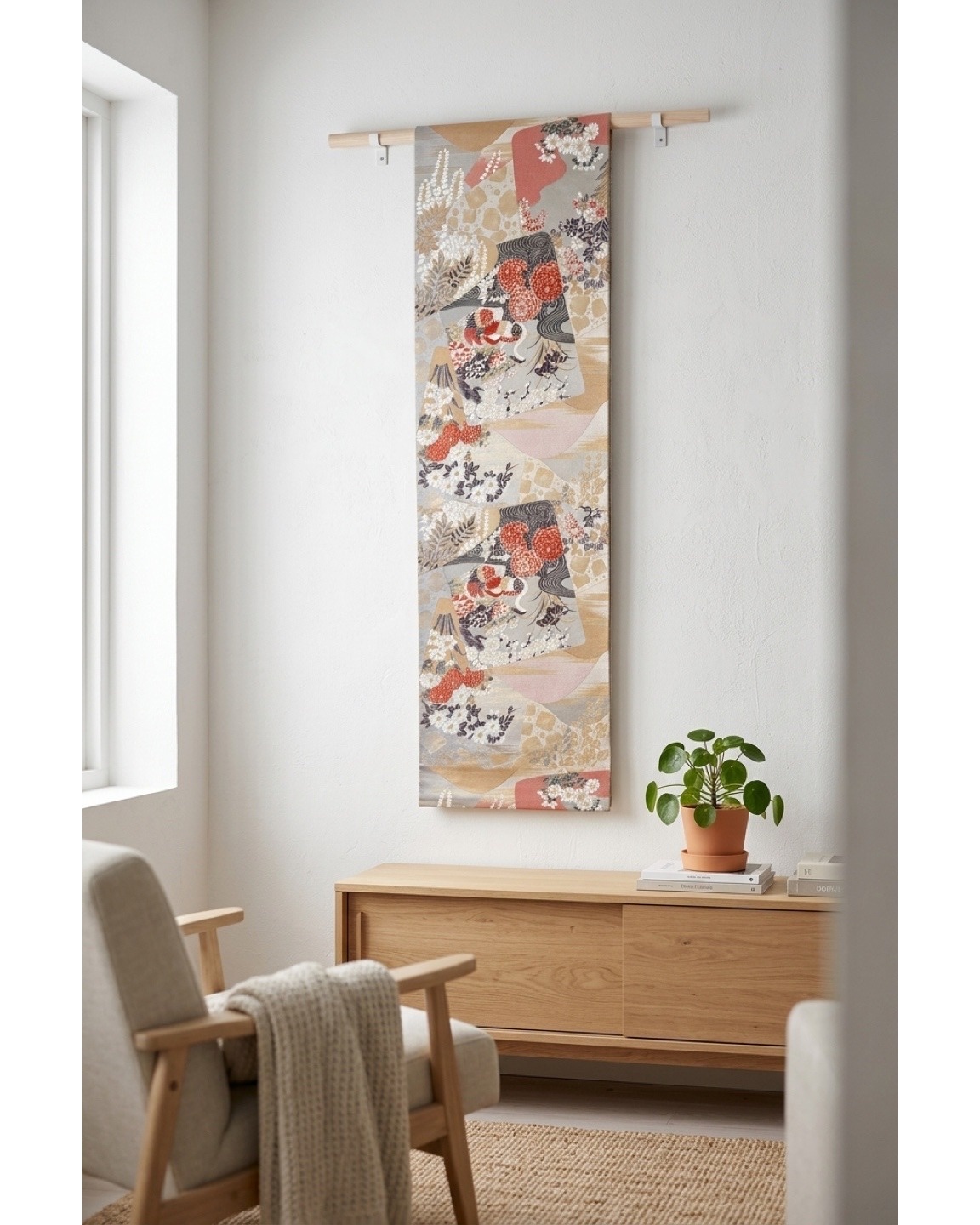
Styling visualization: an AI-generated room scene built from our own product photo. We label every one, on Etsy and here.
How do you care for a vintage silk obi?#
Three rules, and they are the same three printed on every listing. Spot clean only, never machine wash or soak. Keep it out of direct sunlight, which fades silk dye and dulls metallic thread. Store it rolled, not creased, so the fold lines you see on arrival relax over time rather than setting. A gentle steam relaxes storage folds faster; a hot iron on brocade does not. The same rules apply whether the piece is on a table or a wall.
Why is there no restock?#
Every listing we write ends with the same sentence: each obi is one of one, and when it is gone, it is gone. That is a description of the inventory rather than a sales line. Each piece has its own row in our records with its own grade, dimensions, era and defects, and when it sells, that row closes. If you are choosing between two pieces, the honest advice is to decide by what your room needs, because the one you leave will not be there next month.
Browse what is currently available in the KINU Tokyo shop, and if you have a question about a specific piece, ask it. Answering the question is the part we are here for.